
Law Firm Trust Accounting: Three-Way Reconciliation & Common Mistakes to Avoid
Trust accounting is one of the most compliance-sensitive responsibilities a law firm carries. This practical guide walks through three-way reconciliation and the most common mistakes that put firms at risk.
 Stacy Perez

This article is part of the Practical Legal Operations Insights blog series — resources for law firms to work smarter, not harder.
Trust accounting is one of the most compliance-sensitive responsibilities a law firm carries. Errors aren't just administrative inconveniences — they can result in bar complaints, disciplinary action, and serious damage to a firm's reputation. Yet for many firms, trust accounting processes are inconsistently documented, unevenly applied, or left entirely to one person who holds all the institutional knowledge.
This guide covers two foundational areas: how three-way trust account reconciliation works, and the most common trust accounting mistakes law firms make — and how to avoid them.
What Is Three-Way Trust Account Reconciliation?
Three-way reconciliation is the process of confirming that three records agree with one another every month:
- The bank statement — what the bank shows as the balance in the trust account
- The trust ledger — the firm's running record of all trust account activity
- The individual client ledgers — the separate records maintained for each client whose funds are held in trust
All three must match. If they don't, there is a discrepancy that must be identified and corrected before the reconciliation is complete.
The Three-Way Reconciliation Process
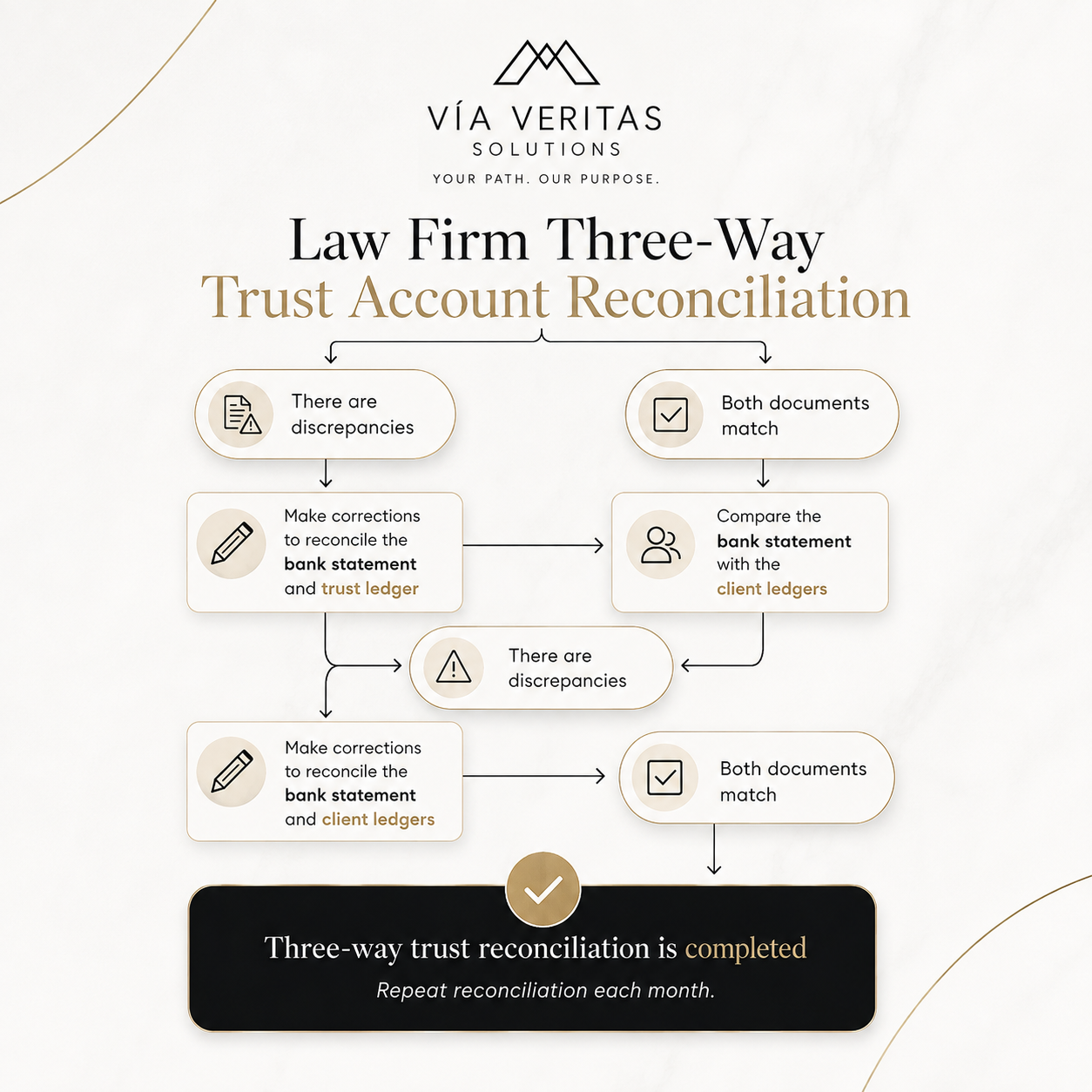
The process works in two stages:
Stage 1 — Bank Statement vs. Trust Ledger
Compare the bank statement balance to the trust ledger balance. If both documents match, move to Stage 2. If there are discrepancies, make the necessary corrections to reconcile the bank statement and trust ledger before proceeding.
Stage 2 — Bank Statement vs. Client Ledgers
Compare the bank statement with the individual client ledgers. Again, if both match, the reconciliation is complete. If discrepancies exist, make corrections to reconcile the bank statement and client ledgers.
Once all three records agree, three-way trust reconciliation is completed. This process should be repeated each month without exception.
Consistent monthly reconciliation is not optional — it is a professional responsibility requirement in Florida and most jurisdictions. Firms that skip months or perform reconciliation inconsistently are exposed to significant compliance risk.
Common Trust Accounting Mistakes — and How to Avoid Them
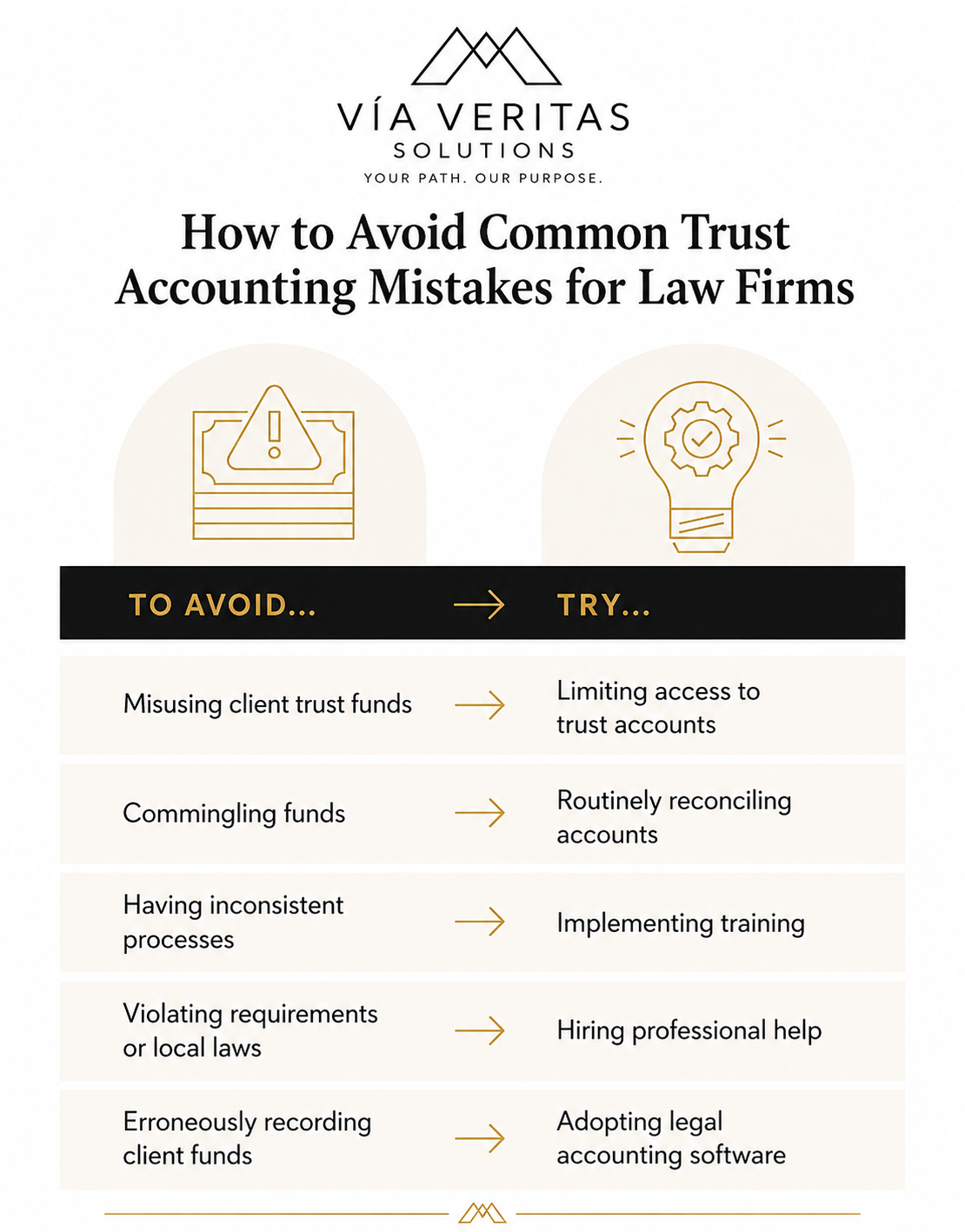
Even well-intentioned firms make trust accounting errors. Here are the most common ones and the practical steps that reduce risk:
| To Avoid… | Try… |
|---|---|
| Misusing client trust funds | Limiting access to trust accounts |
| Commingling funds | Routinely reconciling accounts |
| Having inconsistent processes | Implementing training |
| Violating requirements or local laws | Hiring professional help |
| Erroneously recording client funds | Adopting legal accounting software |
Misusing client trust funds
Client funds held in trust belong to the client — not the firm — until they are properly earned and transferred. Limiting who has access to the trust account and requiring documented authorization for disbursements reduces the risk of misuse, whether intentional or accidental.
Commingling funds
Firm operating funds and client trust funds must never be mixed. Routine reconciliation is the most reliable way to catch commingling errors early, before they compound into larger compliance issues.
Inconsistent processes
When trust accounting procedures vary by person or by month, errors become harder to catch and harder to explain. Documented, written procedures — applied consistently by everyone who touches the trust account — are the foundation of a compliant practice.
Violating requirements or local laws
Trust accounting rules vary by jurisdiction and can change. Staying current with Florida Bar requirements and seeking professional guidance when processes are unclear is far less costly than a bar complaint.
Erroneously recording client funds
Manual entry errors are one of the most common sources of trust account discrepancies. Legal accounting software — such as Clio, which includes built-in trust accounting tools — reduces manual entry, creates an audit trail, and makes reconciliation significantly more straightforward.
How Vía Veritas Solutions Can Help
Trust accounting compliance depends on having the right systems, documentation, and processes in place. At Vía Veritas Solutions, we help law firms:
- Design and document trust accounting workflows so the process is consistent regardless of who is performing it
- Implement and optimize Clio for trust accounting, billing, and reconciliation
- Develop written SOPs for trust account management, disbursements, and monthly reconciliation
- Organize and maintain trust accounting records so your firm is always audit-ready
We are not attorneys and do not provide legal advice. For questions about your specific bar obligations or compliance requirements, consult a Florida-licensed attorney or your state bar's ethics resources.
Clarity. Efficiency. Confidence.
Vía Veritas Solutions
Explore Topics
Written by
Stacy Perez
Founder and Lead Consultant